Emanuel Martoncă, Founder & Pricing Engineer, Soft Fight
Victor was halfway through his coffee when the call came. „We didn’t get it.” He didn’t ask which deal; there was only one. The €2.4 million one. Seven weeks of workshops, reviews, and procurement calls had produced a proposal he was proud of. Sales had signed off, Engineering had signed off, Delivery too. Everyone agreed it was an elegant technical solution to a complex request from a difficult client.
The post-mortem lasted forty-three minutes. Sales thought the customer chose the cheaper vendor. Engineering thought the customer had underestimated the complexity. Delivery said the scope had expanded until the commercial model no longer matched the plan. Nobody raised their voice or blamed anyone, and Victor was left with three explanations and no answer.
Three days later he called Adrian, an old colleague who now ran delivery in another European office. „I need a second opinion. Your opinion.” By Monday, Adrian had read all of it: proposals, contract drafts, every email in between, but had nothing. „I think you lost a good deal, but I just can’t tell you why.” That bothered Victor more than losing had. Two people, forty years of delivery experience between them, and neither could explain the loss.
That weekend Victor came across an article arguing that every lost deal leaves evidence. The claim sounded absurd enough to be worth testing. He would just have to upload one deal: no meetings, no interviews, no explanations, no hindsight. This AI platform would reconstruct the deal from the documents alone. But Legal rejected the idea immediately: „We’re not uploading confidential documents to an external AI.” Victor didn’t have an answer to that objection, only curiosity. He decided it was worth the effort and over the next few evenings he built an anonymized copy of the deal files, erasing anything that could identify either side, then sent it for analysis. Anonymizing a deal, he found, means reading it again, properly, in all its glory. It would have been nice to have won it.
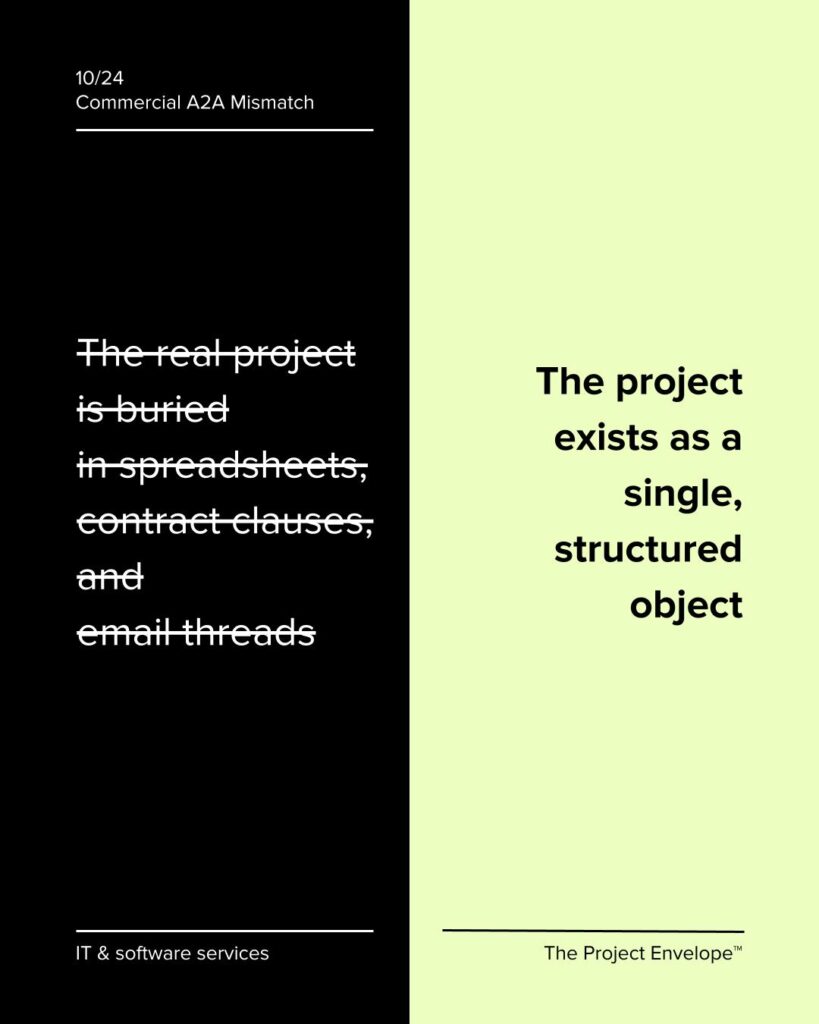
The reports came back, and Victor expected to be told why they’d lost. Instead, he was shown something worse. Sales had been talking about one project, Engineering had designed another, Delivery had planned a third, and Legal had negotiated a fourth. They were not different enough for any human to notice, but different enough for it to affect the outcome of the process. The proposal described post-handover support one way; the contract described it another. The implementation plan depended on a procurement milestone nobody owned. Nothing was incorrect, nothing was dishonest, nothing would have looked wrong reading one document at a time.
Victor checked it himself: the paragraph about support, worded one way in the proposal and another in the contract, and the procurement dependency Engineering had flagged once, that Procurement never answered. None of it was new: every sentence came from documents his own company had written. Nobody had ever assembled it into a single object.
He called Adrian again. „Did you notice the contradiction in the support section?” „…what contradiction?” „I didn’t either.”
Delivery managers don’t need to be careless to make mistakes. It’s enough to be human. For years, proposals were written for people who filled in the gaps, who understood what wasn’t fully said because everyone at the table already knew what was meant. Nobody ever called that a mistake; it was just how the work got done. AI doesn’t do that. It doesn’t interpret; it compares, checks, and asks whether the proposal, the pricing, the contract and the negotiations describe the same deal. If they don’t, it doesn’t assume they eventually will.
That evening, Victor did more research online. He learned that buyers weren’t only using AI to read proposals; they were using LLMs to decide whether a proposal is worth requesting at all. He came across Similarweb’s 2026 Generative AI Brand Visibility Index, which found that over 35% of buyers start their discovery directly inside an AI tool rather than a traditional search engine. They weren’t using it just to compare capabilities, experience, or rates; they were trusting AI-generated answers to decide which vendors were worth contacting in the first place.
Every month, new AI participants join the commercial process: they don’t attend discovery calls, they do not play formal roles in negotiations, and never ask for clarification. They simply read everything, exactly as written.
Victor called Adrian one more time. „I know why we lost. It’s because we all reviewed the proposal, but we were all looking at different deals.” There was no answer from the other side, just a painful silence. Then Victor said it plainly. „Experience isn’t enough anymore. Sign-off doesn’t mean we’re looking at the same deal. We have to accept that every commercial deal now requires a second opinion from AI.”
PS.
Victor and Adrian are fictional characters. Their story, their challenges, and the solution to their problem are as real as it gets. AI now makes it easier to create value and harder to get paid for it. The fix for software providers is to change how they sell and price their expertise and capabilities. The Project EnvelopeTM is the protocol our team uses to reconstruct commercial projects from proposals, contracts, pricing and negotiations as a single structured object.