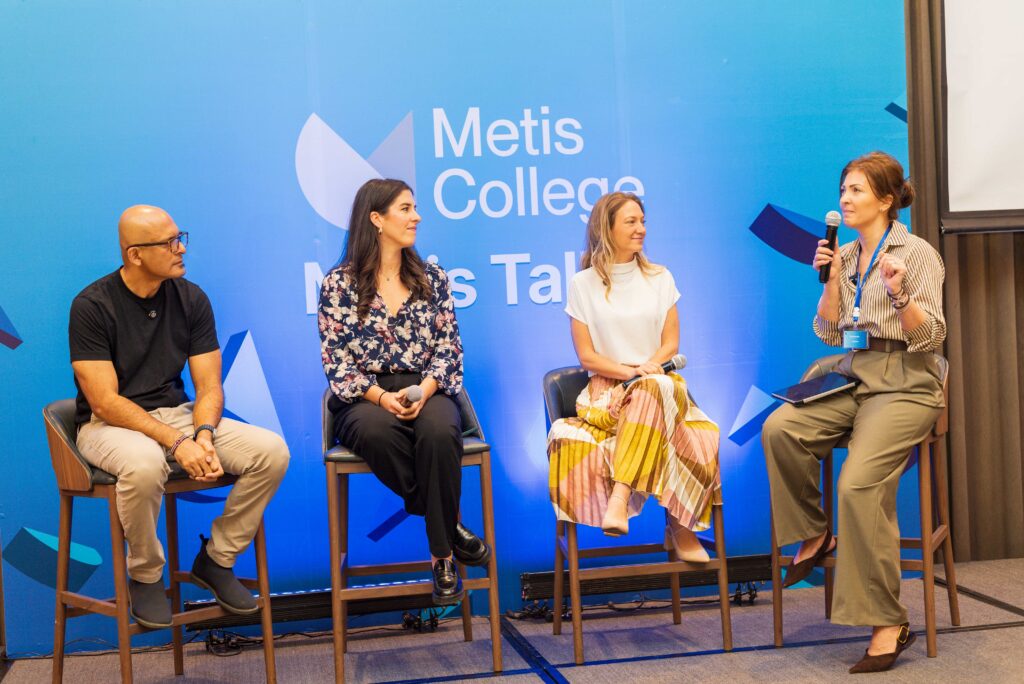
Author: Irina Butnaru | VP of Global Learning, Athena | Managing Director, Metis College | Consultant, Author & AI Fluency Educator
A recent Forbes article named the degrees losing economic value fastest: Marketing, Communications, Generic Business Administration, and Computer Science. Not because those fields are irrelevant — but because the generic version of them is. Generalists get filtered out. Specialists get hired. The value moved. Most professionals are still looking for it in the wrong place.
That’s not a technology problem. It’s a fluency problem.
Most People Are Fooling Themselves
Here’s the uncomfortable truth: 88% of organizations use AI in at least one function. Yet only 12% of workers use it daily. And of those who do — most are simply doing existing work slightly faster.
Zapier’s AI Fluency Rubric (March 2026) makes this visible. It defines four levels: Unacceptable, Capable, Adoptive, and Transformative. Most people who believe they are fluent are sitting at Capable — using AI regularly, seeing some gains, but unable to show how their work has fundamentally changed. The rubric’s most damning line describes the Unacceptable tier: „the work they do before and after AI looks largely the same.” That sentence describes far more professionals than would admit it.
The goal is Transformative: AI is not a tool you reach for — it’s a shift in how work is designed. You re-engineer processes, build systems that run without you, and raise the floor for everyone around you.
Goldman Sachs estimates generative AI will add $7 trillion to global GDP. The World Economic Forum projects 170 million new jobs by 2030, alongside 92 million displaced. Which side of that equation you land on is determined by your level of fluency — not your access to tools.
We Learned Technology the Wrong Way — and It Worked. Until Now.
Millennials and every generation before learned technology by doing. We clicked around, broke things, figured it out. For the internet, smartphones, and social media — tools that were bounded and transparent — it worked.
AI is none of those things.
It is persuasive, confident, and fluent — even when it’s wrong. It produces outputs that look finished, which is precisely what makes discovery so dangerous here. Anthropic’s 2026 AI Fluency Index calls this the „artifact paradox”: when AI generates polished outputs, users become measurably less likely to question them. The better AI performs, the more it quietly displaces the critical thinking of the person using it. You think you’re in control. The rubric says otherwise.
Discovery learning gets you to Capable at best. Reaching Transformative requires something discovery never demanded: understanding why before you act, not just how. That requires structured development — intentional, progressive, and honest about where you actually are.
Fluency Is Not Literacy. The Distinction Is Everything.
Most organizations are training for the wrong outcome — building AI literacy, not fluency. Literacy is the floor. It means understanding what AI is and how to prompt it. Necessary, but not enough.
Researchers Rogers and Carbonaro define AI fluency as „moving from understanding to creating” with AI — applying judgment where the model falls short, redesigning workflows rather than just automating them. Fast Company adds: breakthrough doesn’t require more AI skills. It requires the human skills AI amplifies — reading a room, selling a vision, owning an outcome. Those are what Forbes identifies as surviving the degree disruption, and what moves someone from Adoptive to Transformative.
What Building Fluency at Scale Actually Looks Like
At Athena — supporting over 3,000 executive assistants working alongside AI daily — we don’t debate whether AI belongs. It is part of our culture. What we track through our AI Fluency Framework is not adoption. It is progression: where each person sits on the spectrum, and what structured development moves them forward.
What we observe consistently: the professionals who advance fastest are not the most technically confident. They combine AI capability with strategic judgment and the discipline to push back when an output isn’t good enough. They use AI to build things that run without them — not just to finish today’s task faster.
That is also the foundation of Metis College’s MBA program — developing the strategic mindset and entrepreneurial thinking that move people from operators to leaders. Because that is where the value now lives.
The Question That Matters
Workforce readiness shows up as demonstrated competence in real work — not course completion, not self-assessment.
So the honest question is not „Do you use AI?” It’s: Does your work look different because of it?
Not faster. Fundamentally different. Reimagined. Built on systems that extend your judgment beyond what you alone could do.
That is not something you stumble into by experimenting with tools on a Tuesday afternoon. It has to be built deliberately — with the same rigor, structure, and accountability we apply to any other critical professional capability.
The professionals who lead the next decade will not be the ones who used AI the most. They will be the ones who understood it deeply enough to reach Transformative — and had the honesty and self-awareness to know exactly where they still aren’t.
Sources: Forbes, Jodie Cook, „10 College Degrees AI Is Making Redundant Right Now” (April 2026); Goldman Sachs, „Generative AI Could Raise Global GDP by 7%”; World Economic Forum Future of Jobs Report 2025; Zapier, „AI Fluency Rubric” (March 2026); Anthropic, „AI Fluency Index” (February 2026); Chief Learning Officer, „From AI Access to Workforce Readiness” (March 2026); Fast Company, „Maslow’s Hierarchy of AI Fluency Training”; Rogers & Carbonaro, „Why the Difference Between AI Literacy and AI Fluency Matters” (February 2026)